How to Avoid Misinterpreting French Test Results


The province of Quebec accepts a variety of international exams to assess French language proficiency; the best known of these are: the TEF Quebec or TEF Canada, but even with these tests, there is widespread confusion when it comes to interpreting the scores for each proficiency level.
As a consultant registered with Quebec’s MIFI (Ministry of Immigration, Francization, and Integration), I must warn applicants of the risk of losing their eligibility for an immigration program and failing to obtain the CSQ if they misinterpret their results.
That's why today I want to share a practical tip that will help you avoid these mistakes and understand how to correctly interpret your results based on the official tables.
A Common Mistake: Confusing the CLB/NCLC Score with the Echelle Quebecois
To avoid misinterpretations of the results, it is essential to correctly define each acronym and to understand that, although they appear to be the same, they operate in different dimensions depending on the province.
What do these acronyms stand for?
- CLB stands for Canadian Language Benchmarks.
- NCLC is the French acronym for Niveaux de compétence linguistique canadiens.
It is important to note that the acronyms CLB and NCLC refer to the same Canadian national standard for measuring language proficiency. The only difference is that the acronym CLB is used when referring to English, and NCLC is used when referring to French.
Depending on the language of the exam, the result will be expressed using either the CLB or the NCLC; however, both terms refer to exactly the same federal assessment standard.
Échelle Québécoise: Tip for Avoiding Misinterpretation
The Échelle Québécoise is the Quebec Scale of French Language Proficiency Levels. It is the only valid scale for determining equivalencies between language proficiency levels, and it is used in Quebec’s assessment processes, such as the Quebec Selection Certificate (CSQ).
Widespread confusion arises when candidates try to interpret their French test scores for an application process in Quebec using the logic of the federal CLB/NCLC.
It is essential to understand that the CLB/NCLC score and the Échelle québécoise are based on different assessment frameworks and should not be interpreted as equivalent.
Real-Life Case of Misinterpretation of Results
In my immigration practice, I have had clients who are concerned because they see that their score is below the standard score on the CLB scale.
Recently, a client thought she had fewer points than required for her Quebec application. Her TEF test results showed 429 points in Oral Expression.
When she compared that score to a chart she believed was the standard one (thinking in terms of the CEFR), she realized that her score corresponded to Level 6. Since the CSQ program required Level 7, she was convinced she didn't qualify.
When we reviewed his results based on the Échelle québécoise, we discovered that his score did not correspond to Level 6, but rather fell into the category equivalent to Level 7 or 8 on the Quebec language proficiency scale, meaning he did indeed have the required proficiency for the process.
IMPORTANT! When evaluating your French test scores, you must use the official Quebec scoring tables.
Correlation Tables Between Test Scores and Levels on the Quebec Scale of French Proficiency (Version dated November 29, 2024)
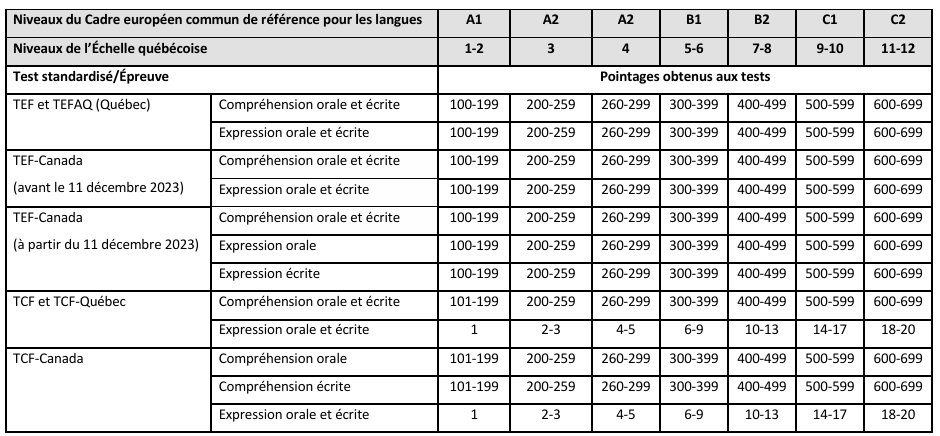
Source: TAB_PSTQ_Correspondance_niveaux_francais (4).pdf
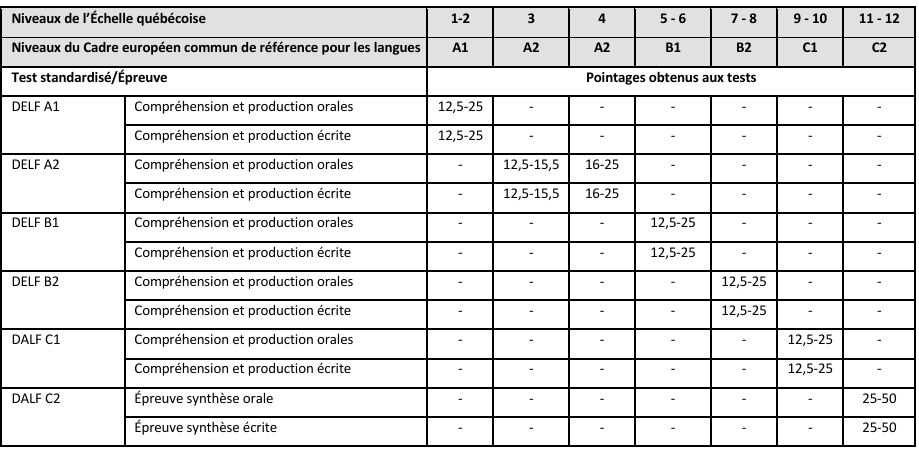
Source: TAB_PSTQ_Correspondance_niveaux_francais (4).pdf
Recommendations for Your Process in Quebec
Remember that the province of Quebec administers its immigration processes according to its own laws, which differ from those of the federal system. What works for the rest of Canada does not always apply in the same way in Quebec.
In summary, be sure to consult the "French Proficiency Level Chart" specific to Quebec programs.
If you have any questions, seek advice from consultants regulated by MIFI who are familiar with the technical differences in your processes.
You can find out about other accepted exams for assessing your French proficiency by clicking on "French Exams and Certificates."
Specialized Consulting in Quebec
To answer your questions and provide you with up-to-date information on Quebec's programs, we have provided the following links:
- Specialized consulting services for Quebec.
- Schedule an appointment with Carolina Feican (COO & Regulated Consultant CICC with QC MIF).
- Appointment for CSQ Checkups
I hope this topic proves useful to you as you move forward. See you in our next blog post, where we’ll continue to help you build your Canadian dream with empathy and professionalism.
With love,
Immiland Canada
Note: This article does not constitute legal advice or legal opinion from an attorney. Rather, it is provided solely to inform readers about certain aspects related to the details of the law in legal matters.
Latest on Instagram


Migration services
with professional support
Immiland is regulated and authorized by the Law Society of Ontario (LSO #89482N) and by the College of Immigration and Citizenship Consultants (cicc #r515840). (CICC #R515840),
2025 Rue Parthenais
suit 320
Montreal, Quebec, Quebec,
Canada